
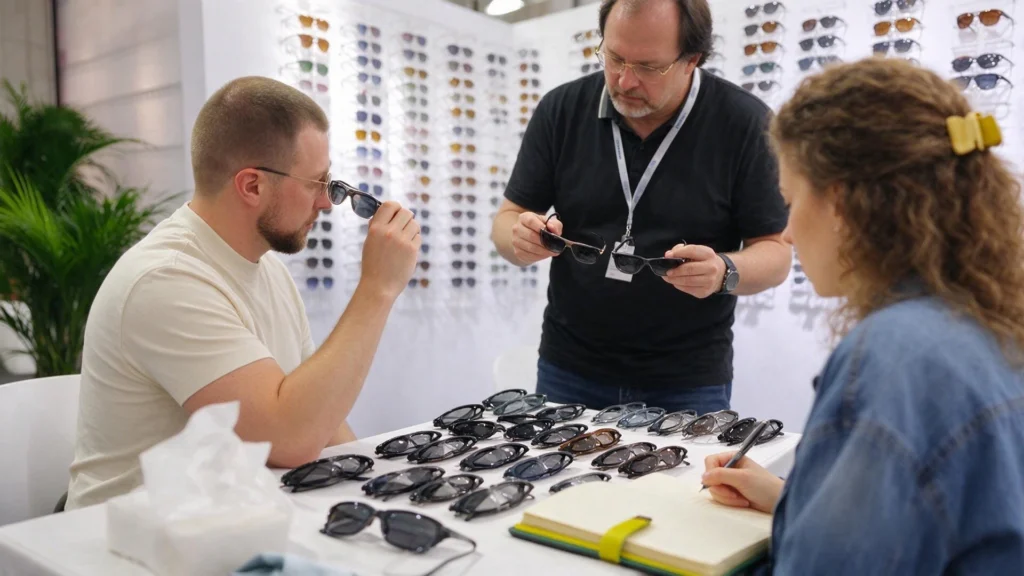
Wenzhou eyewear manufacturers operate inside one of China’s densest eyewear supply chains: the Ouhai optical district concentrates frame development, tooling, hardware, plating and polishing, lenses, assembly and export handling within a short radius. Cluster access is a lead, not proof — it tells you where capability is likely, never which factory will run your order well. This map turns the cluster into a decision path: define the product and destination, freeze measurable specifications, verify process responsibility at the exact site, approve a controlled sample, and release the order only against agreed evidence.
PUPULAN is a sourcing and export service company that maps, benchmarks and coordinates independent eyewear factories in this ecosystem; it does not manufacture. The guide is written for importers, brands, wholesalers and procurement teams evaluating the Wenzhou eyewear supply chain for optical frames, sunglasses or private label programs.
Key Takeaways
1. Cluster access is a lead, not proof. The Ouhai ecosystem raises the odds of finding a capable factory; it proves nothing about the one you are talking to. Verify the entity, the site and process responsibility order by order.
2. Map the chain before you map the factories. Hardware, plating, polishing and lens work are commonly split across specialized workshops. Which steps a factory keeps in-house — and how it controls the rest — is the fastest capability test you can run.
3. Comparable quotations start from one frozen specification. Price spreads in this cluster usually trace to hinge hardware grade and polishing passes, not margin. Write both into the RFQ and spreads become explainable.
4. Release orders against evidence, not assurance. A sealed golden sample ID, an agreed AQL inspection plan and destination-market documentation decide shipment release — in that order, before the balance payment.
What the Wenzhou Eyewear Supply Chain Can and Cannot Prove for a Buyer
The Wenzhou eyewear supply chain can prove depth of supply: a district-scale concentration of frame making, hardware, finishing and assembly, represented nationally by China’s national eyewear industry association — the sector’s only national industry body (checked as of 2026-10-11). What the map cannot prove is whether the factory in front of you will produce your order well. Cluster membership and company capability are different claims, supported by different evidence, and buyers who merge them award orders on geography and argue about quality later.
Four evidence tiers run through this guide. Known facts are publicly checkable: the industry association, the government’s cluster quality program, the trade fair. Conditional judgments are probabilities — a factory inside the Ouhai optical district is more likely to hold eyewear process depth than one outside it. Supplier statements — process lists, certificates, capacity claims — stay statements until tied to your model, your materials and the site that will run the order. Buyer-verified evidence is what you create: registry extracts, site audits, your own samples, your inspection reports. Decisions should weight the tiers in exactly that order.
| Signal | What it supports | What it cannot prove |
|---|---|---|
| National industry body framework | A organized sector with national representation and a standards environment | Any individual factory’s process depth or consistency |
| Government cluster quality program (Ouhai) | Cluster-level quality infrastructure, standards work and brand development | That your order, at your site, will meet your specification |
| Trade fair exhibitor listing | The company exhibits and is oriented to export trade | Production ownership — exhibitors may assemble rather than make |
| Marketplace storefront and certificate images | Product range and claimed credentials, as leads worth checking | Certificate validity for your model, material and production site |
If a supplier’s pitch stops at the cluster’s reputation, ask what the factory itself controls. The answer either opens the next verification step or closes the conversation before your deposit is at risk.
Read the full guide here : [ Wenzhou eyewear industrial belt overview ]
How the Wenzhou Eyewear Supply Chain Is Structured
The Wenzhou eyewear supply chain runs as seven linked stages: frame development, tooling, materials and components, surface finishing, lenses, assembly and branding, and inspection with export coordination. Few factories own every stage. Acetate specialists mill and polish sheet; metal specialists form, weld and send parts out for plating; lens work often sits with dedicated lens suppliers rather than the frame factory. The map below shows what happens at each stage, who typically performs it, and the evidence a buyer should request. Read it before comparing factories — your construction choice decides which stage owners you actually need on your side.
| Stage | What happens there | Commonly performed by | Buyer evidence to request |
|---|---|---|---|
| 1. Frame development | Style converted to an engineering drawing: dimensions, tolerances, size notation, material calls | Factory design room or an independent developer | Drawing with revision number and stated measurement methods |
| 2. Tooling and molds | Molds for injection fronts; forming tools for metal parts | The factory or a dedicated mold shop | Mold ownership and custody terms in writing |
| 3. Materials and components | Acetate sheet, metal wire and sheet, hinges, screws, nose pads, cases | Component markets and hardware specialists | Hardware grade and material specs named on the RFQ |
| 4. Surface finishing | Tumbling and hand polishing, electroplating, painting, printing | Often subcontracted finishing specialists | Who runs each step and how the partner is controlled |
| 5. Lenses | Stock lenses cut and edged; sun-lens tinting to a named filter category | Dedicated lens suppliers | Lens specification plus the destination-market standard |
| 6. Assembly and branding | Glazing, logo application, fitting, retail packaging | The frame factory | Golden sample reference cited in the purchase order |
| 7. Inspection and export | Final random inspection, export documents, booking and container loading | Factory QC plus the buyer’s inspection coordination | Inspection report and a complete, consistent document set |
The Ouhai optical district and its quality infrastructure
The cluster’s center of gravity is the Ouhai optical district, where Wenzhou’s market-supervision authority runs a dedicated quality-infrastructure service platform for eyewear firms — including help clearing technical barriers such as nickel release — alongside standards leadership and a certified-brand program across the cluster (Ouhai eyewear industrial cluster quality program, checked as of 2026-10-11). The district’s rise from early workshops to a planned eyewear town, later extending toward eye-health industries, is told in the local government’s own long-form history (from an eye chart to the Ouhai Eyewear Town, checked as of 2026-10-11).
The trade calendar is anchored by the Wenzhou International Optics Fair, running since 2003 and positioned by its organizer as a window for eyewear manufacturing and export trade backed by the industrial base (checked as of 2026-10-11). None of this infrastructure produces frames by itself. It lowers the cost of finding and checking the factories that do — which is exactly how a buyer should use it.
Specialization is the cluster’s operating logic, and that is why subcontracting is normal here. The useful question is never whether a factory outsources, but which processes it keeps in-house and how it controls the ones it does not.
Which Supplier Capabilities Must Be Verified at the Exact Site
For Wenzhou eyewear manufacturers, five capabilities can only be verified at the exact site that will run your order: the legal entity behind the quotation, physical control of the processes your construction depends on, tooling ownership, quality-control discipline, and consistency between the sample room and the production line. Every one of them can be checked with documents, a walkthrough and a trial order — and every one of them is invisible in a catalog, a storefront or a certificate image.
- Entity match: business licence and unified social credit code, checked against the name on the quotation, the contract, the invoice and the bank account beneficiary.
- Site match: the factory address confirmed against the registration address, by visit or live video walkthrough.
- Process control: which stages are in-house and which are subcontracted — for outsourced plating or polishing, the partner’s identity and how it is audited.
- Tooling ownership: whose mold runs your production, and who may move or replace it.
- QC discipline: the inspection station, the sampling plan the factory applies, and its acceptance of your own AQL plan.
- Production consistency: whether the line that ran your sample is the line that will run your order.
If a factory will not name its plating or polishing partner, treat the entire process chain as unverified. A low quotation from an unnamed chain is a reason to investigate, not a saving.
How to find eyewear factories in Wenzhou
Discovery follows a funnel. Leads come from trade fair exhibitor catalogs, industry directories and marketplace storefronts; the fair organizers from Wenzhou also run a global eyewear sourcing show organized from Wenzhou for overseas buyers, which shortens first contact (checked as of 2026-10-11). Shortlist by construction match — acetate, metal or injection — then send one identical evidence request to every candidate: business licence, in-house versus subcontracted process list, export references you may contact, and audit willingness. What survives that filter goes to site verification, a paid sample and a trial order.
Read the full guide here : [ How to find suppliers in China ]
How to Build a Comparable RFQ and Sample-Approval Process
Two quotations are comparable only when they price the same object — and that object is a frozen specification sheet. One document, revision-numbered, listing geometry, materials, hinge hardware, finish, lens plan, logo, packaging and commercial terms, sent unchanged to every candidate. The table below lists the RFQ line items that decide whether a Wenzhou eyewear quotation can be compared, negotiated and defended later. Collect itemised prices against these lines: a single blended number hides exactly the assumptions you will argue about after the deposit.
| Line item | Freeze before quoting | Why it moves price |
|---|---|---|
| Frame family and material | Acetate, metal or injection; material grade; rim type | Decides the process chain and the factory profile you need |
| Hinge hardware | Type, barrel count, spring specification, screw type | Hardware grade is a common source of quotation spreads |
| Surface finish | Polish level, plating specification, color codes | Each polishing or plating pass adds real process cost |
| Lens plan | Unglazed or glazed; filter category; destination standard | Glazing, lens grade and testing change scope and cost |
| Logo and artwork | Method, position, artwork file version, trademark ownership | Tooling and setup differ by method and complexity |
| Packaging and labeling | Case type, cloth, carton count, barcodes, destination-language labels | Retail-ready packaging is a cost line, not an afterthought |
| Commercial terms | FOB, CIF or DDP under Incoterms® 2020 with a named place; currency; T/T or L/C | Different terms price different obligations — never mix them in one comparison |
| Compliance documentation | Which test reports and labels the destination requires, and who arranges them | Testing scope shifts lead time and unit cost |
Benchmarking quotations in this cluster points to a repeated pattern: spreads between Ouhai factories usually trace back to hinge hardware grade and the number of polishing passes, not to margin. Two quotes against the same drawing can differ for legitimate engineering reasons — start the supplier conversation at those two lines and the gap becomes explainable instead of emotional. This is practitioner judgment from fifteen years of order-level sourcing; the lines that test it are on your drawing, not in a statistic.
Private label eyewear Wenzhou: freeze these details before sampling
Private label programs add four fields to freeze before any sample is made: the logo method — engraving, laser marking, stamping or a metal plaque — with position and artwork file version; trademark ownership, which must be your own registered mark; tooling ownership, decided before any deposit changes hands; and packaging dielines with barcode and label content. Minimum order quantities are not fixed industry numbers: MOQ varies by product category and supplier — confirmed at quotation stage. Freeze the four fields first, because each is cheap to change on paper and expensive to change on tooling.
Sample approval then works as measurement, not as a style preview: dimensions against the sheet, hinge action on both temples, finish against the color master, logo position and legibility, weight, packaging. Seal two identical golden samples — one at the factory, one with you — reference the sample ID in the purchase order, and route any change of material, process or subcontractor through written change control. The product-level depth of this method is covered in the companion guide below.
Read the full guide here : [ Sourcing optical frames from Wenzhou ]
Quality, Documentation and Destination-Market Evidence Gates
Order release rests on three evidence layers: batch quality, the documentation chain, and destination-market gates. Batch quality is a final random inspection at the supplier site against an agreed AQL sampling plan — the ISO 2859 family is the usual reference — with critical, major and minor defect classes agreed in writing before production starts. The documentation chain ties the batch to test reports matched to your model, material and destination. Destination gates confirm the product meets the rules of the market it enters. Layer one without layer three passes cartons a market may reject; layer three without layer one certifies a batch you never checked.
| Market | Typical evidence gate | Watch items |
|---|---|---|
| European Union | General Product Safety Regulation (EU) 2023/988 — traceable economic operator and product identification for products placed on the market (applicable since 13 December 2024); REACH substance restrictions, including nickel release for parts in prolonged skin contact; sunglasses fall under the PPE Regulation (EU) 2016/425 as Category I equipment, with EN ISO 12312-1 commonly referenced for sunglasses performance | Economic-operator details in the file; test reports matched to model, material and production site |
| United States | Impact-resistant lens requirement for eyeglasses and sunglasses under FDA regulation 21 CFR 801.410; ANSI Z80.3 commonly referenced for nonprescription sunglasses performance | The FDA standard has been under rulemaking review — verify the current text; scope if frames ship glazed |
| UK, Canada, Australia, Middle East | Labeling, language, marking and testing per importer agreement and destination rules | Confirm gate by gate with your customs broker before the first shipment |
None of this is a universal certificate checklist. Obligations bind per exact product, material, user and destination, and the current primary sources govern at order time: verify GPSR economic-operator details, REACH applicability and the lens standards for your exact SKU with your testing laboratory or customs broker. Statuses above are as of 2026-10-11 — recheck quarterly.
Limitations of this map. It applies to fashion optical frames, sunglasses and reading glasses in conventional acetate, metal and injection constructions at export volumes. It is not a path for certified protective or safety eyewear, which follows separate impact and sector standards, nor for lens optical design, which belongs with your lens laboratory. It assumes a frozen specification and agreed inspection gates; without them, no sourcing route — factory-direct, trading company or coordinated — produces comparable quotes or enforceable quality. Rules, freight and supplier status change: verify at quotation time and recheck quarterly.
When a Direct Factory, Trading Company or Sourcing Partner Fits the Order
A direct factory fits buyers who already own specifications, inspection capacity and import experience, and who concentrate volume in one construction. A trading company fits simple resupply, where an extra margin buys convenience. A sourcing partner fits the common middle case: buyers testing several factories or several categories at once, without a team in China, who need supplier verification, quotation benchmarking and one accountable coordinator from sampling to shipment. The matrix below turns that judgment into an order-profile decision.
| Your order profile | Direct factory | Trading company | Sourcing partner |
|---|---|---|---|
| Single frame family, repeat volume, own QC team | Best fit | Workable | Workable |
| Multi-SKU container mixing eyewear with other categories | Weak fit | Workable | Best fit |
| New brand, first order, no team in China | Weak fit | Workable | Best fit |
| Price benchmarking across several factories | Not neutral | Limited visibility | Best fit |
If your container mixes eyewear with footwear, hardware or general merchandise, then mixed-container consolidation under one coordinator beats parallel factory negotiations — reconciliation happens at SKU level, and one team owns the documents.
PUPULAN works this way as an eyewear sourcing agent in China and across eight further categories: supplier development and verification, quotation benchmarking, sampling coordination, order follow-up and milestone tracking, pre-shipment inspection coordination, mixed-container consolidation, export documentation and customs handling, and DDP door-to-door delivery. Read about PUPULAN and our company profile — including registered business details — on the about page.
Read the full guide here : [ Multi-category consolidation ]
Read the full guide here : [ Eyewear category overview ]
The Wenzhou Eyewear Supplier Mapping Worksheet
The worksheet below is the working tool this article was built around — the NEXT-STEP ASSET that turns the map into a decision record. Complete one column per candidate factory, reference it in every RFQ and inspection report, and re-version it whenever anything changes. A completed worksheet is also your shortest brief to any sourcing coordinator you later appoint.
| # | Field | What complete looks like | Your entry |
|---|---|---|---|
| 1 | Product and destination | Acetate sunglasses, EU retail channel | |
| 2 | Specification sheet status | Rev. A frozen, tolerances and measurement methods stated | |
| 3 | Construction family | Acetate / metal / injection / mixed | |
| 4 | Legal-entity match | Licence and unified social credit code match quote, contract, invoice, bank | |
| 5 | In-house vs subcontracted map | Outsourced steps listed; partners named and audited | |
| 6 | Tooling and mold ownership | Owner named; custody and removal terms in the contract | |
| 7 | Hinge and hardware grade | Type, barrel count, spring, screw named on the drawing | |
| 8 | Surface finish specification | Polish level, plating specification, color codes | |
| 9 | Lens plan and standard | Glazed or unglazed; filter category; destination standard named | |
| 10 | Golden sample | ID sealed and dated; referenced in the purchase order | |
| 11 | Inspection plan | AQL classes agreed in writing; final random inspection before release | |
| 12 | Destination evidence gate | GPSR / REACH / lens-standard file status for your market | |
| 13 | Decision | Advance / verify more / drop — with the reason written down |
If any worksheet row is still blank, the quotation is provisional — close the row before releasing money, not after.
Frequently Asked Questions
is Wenzhou good for eyewear manufacturing
Yes — Wenzhou is one of China’s core eyewear clusters: the Ouhai optical district concentrates frame making, hardware, plating, polishing and assembly, supported by a national industry association and the Wenzhou International Optics Fair, which has run since 2003. Cluster depth improves your odds of finding a capable factory; it does not prove any individual one, so verify the factory itself before awarding the order.
how do I find eyewear manufacturers in Wenzhou
Treat exhibitor lists, industry directories and marketplace storefronts as leads, then filter by construction — acetate, metal or injection. Ask each shortlisted Wenzhou eyewear manufacturer for a business licence, a list of in-house versus subcontracted processes and an audit or live video walkthrough, and finish with a paid sample and a small trial order. Verification at the actual site, not catalog comparison, is what separates suppliers.
what parts of eyewear production are commonly subcontracted
Commonly subcontracted steps include electroplating, polishing, hinge and screw supply, and sometimes lens edging or mold making. The split matters because quality control travels with the process: a factory that controls assembly but outsources plating must still show how it audits the plating partner. Ask every candidate to list which processes are in-house, then verify the answer during a site visit or inspection.
how do I verify a Wenzhou eyewear supplier
Verify documents first, then the site, then the sample: check the unified social credit code and business scope in the company registry, confirm the same legal name on quotation, contract, invoice and bank account, inspect the processes your construction depends on — milling, molding, forming, plating — and close with a golden sample plus final random inspection under an agreed AQL plan. No single document proves a supplier; the chain does.
Do you offer private label eyewear from Wenzhou?
Yes. PUPULAN coordinates private label eyewear through the independent factories we work with: sampling under your artwork and trademark, order follow-up, inspection coordination, consolidation and export documentation. We are a sourcing and export service company, not a manufacturer, and feasibility for a specific design, logo method and destination is confirmed at quotation. Send your reference styles and target market to start the mapping.
Can I mix eyewear with other categories in one container?
Yes — mixed-container consolidation lets one buyer combine eyewear with footwear, hardware, apparel or general merchandise in a single shipment. Orders are reconciled at SKU level rather than by counting cartons, and the same file covers export documentation and, where agreed, DDP door-to-door delivery. For buyers testing several Wenzhou product lines at once, this is usually the cleanest structure.
Sources and review dates
- China National Eyewear Association (chinaoptics.com), the Wenzhou International Optics Fair (opticsfair.cn), the organizers’ international sourcing show (opticsfair.com), the Ouhai eyewear cluster quality program (Wenzhou government) and the Ouhai Eyewear Town history (Wenzhou social sciences) — each linked once in the body above, checked as of 2026-10-11.
- GPSR (EU) 2023/988, REACH, Regulation (EU) 2016/425, EN ISO 12312-1, ANSI Z80.3, 21 CFR 801.410 and the ISO 2859 family are named in the text without links; verify current texts with your testing laboratory or customs broker — as of 2026-10-11, recheck quarterly.
- Preparation note: this guide was drafted with AI assistance, and every external fact, link, standard name and review date in it was human-verified against the sources above as of 2026-10-11.
- AQL acceptance classes and tolerance starting points are common industry starting points agreed per order, not statistical claims. PUPULAN states no factory counts, capacity figures or prices in this article.
Map and Compare Wenzhou Eyewear Manufacturers
Send your product, destination market, current specification status and target quantity. You receive a supplier mapping path with benchmarked, itemised quotations and the verification steps behind them. Early stage and no specification yet? Send reference styles and target market — the worksheet can be built from those first.
Contact PUPULAN for Your InquiryJayden, Founder of PUPULAN
“Trade is built on trust. My job is to make sure every Pupulan shipment earns it.”
Jayden leads PUPULAN (WENZHOU PUPULAN INTERNATIONAL TRADE CO., LTD.), a sourcing and export service company based in Wenzhou, China. Fifteen years in China export supply chains across supplier verification, sampling, consolidation and delivery. PUPULAN coordinates independent factories for international buyers and does not manufacture. Read more: about PUPULAN and our company profile.