
Sourcing optical frames from Wenzhou · Updated October 6, 2026
Sourcing optical frames from Wenzhou requires a buyer-focused process that connects measurable specifications, supplier evidence, governed sample approval, market-specific compliance checks and documented shipment release.
Quick answer
To source optical frames from Wenzhou with fewer preventable disputes, first define the frame’s intended use and destination market. Then issue a specification that controls dimensions, materials, construction, finish, branding, packaging and test requirements. Verify the legal supplier, actual production site and subcontracted processes; approve a traceable sample under a written document hierarchy; and release the shipment only after agreed inspection, test and document evidence has been reviewed. Wenzhou’s eyewear cluster can widen the supplier pool, but cluster location alone does not prove that a supplier manufactures the frame, controls critical processes or can meet your market obligations.
Key takeaways
What does sourcing optical frames from Wenzhou require?
A useful sourcing process connects five decisions. Each decision creates an input for the next; skipping one normally moves uncertainty downstream, where changes are slower and more expensive.This sequence does not eliminate commercial risk. It makes responsibilities and acceptance criteria visible early enough for the buyer, supplier and service providers to act on them.
Define intended use and destination before requesting a quotation
“Eyewear” is too broad for a reliable quotation or compliance review. The same visual design may be sold as an unglazed spectacle frame, supplied with prescription lenses, fitted with non-corrective sun filters or designed as eye protection. Those are not interchangeable descriptions.| Product scope to confirm | Questions before supplier selection | Why it changes the project |
|---|---|---|
| Unglazed prescription spectacle frame | Will a local optician fit corrective lenses? Who is the responsible manufacturer and importer? | Frame requirements, medical-device roles in some markets, traceability and technical documentation may apply. |
| Glazed prescription spectacles | Who supplies, edges and mounts the lenses? Is each item made to a prescription? | Lens specifications, prescription fulfilment, impact resistance and release records join the frame controls. |
| Sunglasses or fashion eyewear | Are the filters afocal? What category, transmission, UV performance and labeling are intended? | Sunglass-specific standards and claims may replace or supplement spectacle-frame requirements. |
| Protective eyewear | What hazard, workplace and performance level is claimed? | Personal-protective-equipment rules and impact or optical testing may apply; a fashion frame is not evidence of protection. |
The current ISO 12870:2024 scope covers unglazed spectacle frames intended for prescription lenses and expressly excludes eye-protection frames and sunglasses with afocal filters. This is why intended use must be fixed before the test plan.
Freeze optical-frame specifications before quotation
A supplier cannot quote or reproduce what the buyer has not defined. A useful specification distinguishes identity, dimensions, material, construction, visible finish, functional performance, branding, packaging and evidence. Each measurable item should name the method, unit, target and tolerance instead of relying on terms such as “standard,” “good quality” or “same as photo.”Read frame dimensions correctly
The marking 52□18–140 is commonly read using the boxing measurement system. It does not mean that the square symbol itself is the bridge dimension.| Mark or dimension | Controlled meaning | Buyer note |
|---|---|---|
| 52 | A dimension: boxed lens width in millimetres | Define the datum and measuring method on the drawing. |
| □ | Symbol indicating the boxing measurement system | It separates the A dimension from the distance between lenses. |
| 18 | DBL: distance between lenses in millimetres | Do not substitute an unspecified bridge measurement. |
| 140 | Nominal temple length in millimetres | State the measurement path and tolerance. |
| B dimension | Boxed lens height | Useful for lens fit and design evaluation. |
| ED | Effective diameter: twice the greatest distance from the boxing centre to the lens shape edge | It can affect lens blank selection; confirm the exact method with the optical team. |
| Frame PD | A + DBL under the boxing system | Do not confuse it with the wearer’s pupillary distance. |
Control material, construction and finish by component
| Area | Weak instruction | Better control |
|---|---|---|
| Front and temples | “Acetate look” | State the material grade or supplier-declared composition, sheet or injection process, colour reference, thickness points and permitted visual variation. |
| Metal parts | “Stainless metal” | Identify the component, material declaration, surface system, colour target and any release or corrosion-related requirement relevant to use. |
| Hinge | “Good hinge” | Specify hinge type, barrel count if relevant, spring/non-spring design, screw retention, opening feel, alignment and cycle or durability criterion. |
| Attachment | “Rivet style” | State whether the visible rivet is structural or decorative, the fixing method, pull/retention expectation and permitted movement. |
| Surface finish | “Shiny black” | Use an approved colour standard or limit sample, gloss/texture description, viewing conditions and defect boundary for scratches, pits, stains or colour mismatch. |
| Branding | Logo file only | Control artwork version, size, location, colour, process, orientation, adhesion/legibility and legal approval. |
Use an Optical Frame Specification and Fit Sheet
The following is a practical starting structure, not a universal specification. Expand it for the product and market.| Control block | Fields to define | Approval evidence |
|---|---|---|
| Product identity | Buyer SKU, supplier model, colour code, revision, intended use and destination | Signed cover sheet and revision history |
| Geometry and fit | A, B, DBL, ED if needed, total width, temple length, lens shape/file, pantoscopic angle and other design-specific dimensions | Dimensioned drawing with method and tolerance |
| Bill of materials | Front, temples, core wire, hinges, screws, nose pads, tips, inserts and decorative parts | Approved BOM and declarations or test evidence where required |
| Appearance | Colour, pattern, polish, plating/coating, texture, logo and permitted variation | Signed sample plus photos under defined viewing conditions |
| Performance | Dimensional stability, deformation, endurance, perspiration/corrosion or other applicable criteria | Approved test plan and relevant reports |
| Packaging | Sleeve/case, protection, labels, barcodes, warnings, quantity, carton marks and transit configuration | Artwork proof, pack-out sample and carton specification |
| Document precedence | Order of control among law, contract/PO, signed specification, drawing, approved sample and supplier documents | Signed precedence clause and deviation process |
Give every controlled file a revision and date. A change to resin, sheet source, plating system, hinge, screw, logo process, lens shape or production site can affect fit, appearance, testing or compliance; require written approval before implementation.
Verify supplier capability and process responsibility in Wenzhou
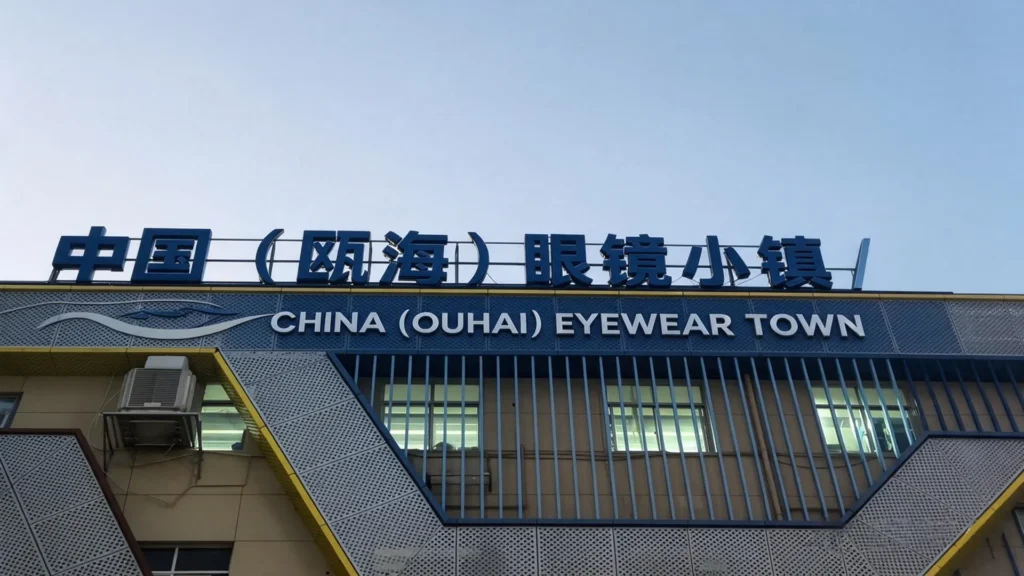
Wenzhou, including Ouhai, has an established eyewear industry cluster. An official Wenzhou source describes local industry-development and service-platform activity. This supports cluster relevance, not a claim that any named company owns a factory, controls every process or meets a buyer’s specification. Start by separating three identities: the legal contracting entity, the sales contact and the actual production site. Then map the process flow. A supplier may machine or form the frame internally while outsourcing sheet cutting, core-wire insertion, soldering, plating, painting, laser marking, lens fitting, testing or final packing. Outsourcing is not automatically a defect; undisclosed or uncontrolled outsourcing is the risk.Use evidence that matches the claim
| Question | Useful evidence | What it does not prove by itself |
|---|---|---|
| Who is the counterparty? | Current registration record, business scope, registered address, bank-account-name match and authorized signatory | That the company makes the goods or is financially reliable |
| Where will production occur? | Site address, live/video or in-person review, dated production records, equipment and work-in-progress relevant to the model | Ownership of every process or ongoing capacity |
| Can the site make this construction? | Process flow, similar-construction samples, tooling plan, control points, operator records and pilot output | That a different material, hinge or finish will perform the same way |
| Are reports relevant? | Laboratory identity, accreditation/scope where relevant, product and material match, model/photo, method, result and date | Coverage of a changed BOM, colour, coating, site or destination rule |
| Can capacity meet the order? | Line-level capacity assumptions, current loading, bottleneck process, subcontract lead time and dated production plan | A guaranteed ship date without execution and release evidence |
Build a market-specific compliance file
No short online checklist can determine an eyewear product’s full legal path. Classification depends on intended use, presentation, construction, lenses, claims, destination and the parties’ roles. The buyer should convert those facts into a written compliance matrix, then have the responsible manufacturer, importer and qualified specialists confirm the current requirements before production and market placement.| Market / topic | Starting point for an order-specific review | Evidence to resolve before release |
|---|---|---|
| EU · spectacle frames | The European Commission’s MDCG 2025-8 Rev. 1 describes a spectacle frame intended to hold lenses before the patient’s eyes as a medical device in its MDR/UDI guidance context. Confirm the exact intended use, device status, economic operators and applicable MDR route. | Responsible manufacturer/importer roles, risk and technical documentation, conformity route, declarations, labeling, traceability/UDI applicability and post-market responsibilities |
| EU · chemical and general safety | For nickel release, the EU’s REACH standards reference includes EN 1811:2023, EN 12472:2020 for coated items and spectacle-frame-specific EN 16128:2015. The General Product Safety Regulation can apply residually where specific Union rules do not cover the same safety aspect or risk. | Material/coating scope, applicable method, model/BOM coverage, restricted-substance evidence, warnings and residual-risk review |
| United States · spectacle frames | The FDA eyewear page identifies spectacle frames as Class I medical devices under 21 CFR 886.5842. They are 510(k)-exempt, but exemption from premarket notification does not remove every other FDA obligation. | Correct establishment/device responsibilities, registration and listing where applicable, quality-system obligations as applicable, labeling, records and importer controls |
| United States · glazed eyewear | When lenses are supplied, review the impact-resistance requirements in 21 CFR 801.410 and the FDA guidance for the actual product. | Lens-lot controls, impact-test records/exemptions if relevant, glazing traceability and release authorization |
| Other destinations | Check the importing country’s current medical-device, consumer-product, chemical, labeling, packaging and customs rules for the exact product and claims. | Local responsible party, registrations, permitted claims, language, marks, reports and import documents |
Important: standards may be voluntary tools, regulatory references or contractual requirements depending on the market and product. Confirm the applicable edition and legal status; do not present a laboratory report as a blanket “certificate” unless that description is accurate.
Approve drawings, samples and changes before bulk production
Sample approval should be a sequence of decisions, not a single courier event. Use separate gates so that a visually attractive sample cannot silently override a dimensional, material or compliance requirement.Require a written deviation request before any change. It should state the reason, affected SKUs/lots, old and new condition, effect on cost/timing/testing, proposed validation and the person authorized to approve it. Silence is not approval.
Design inspection and shipment release before production starts
Inspection should translate the specification into observable checks. Define when inspection occurs, who performs it, what lot is presented, how units are sampled, which equipment and methods are used, how defects are classified, what records are required and who has release authority.Use AQL terminology accurately
ISO 2859-1:2026 provides AQL-indexed sampling schemes for inspection by attributes in a continuing series of lots. An AQL value such as 2.5 is an input to a sampling plan; it is not, by itself, the number of defects automatically allowed in every shipment. A complete instruction should identify the lot size, inspection level, normal/tightened/reduced status where the scheme is valid, single/double/multiple sampling choice, code letter, sample size and the corresponding acceptance/rejection numbers. For a one-off or isolated lot, confirm whether the selected scheme is appropriate instead of applying a continuing-lot table mechanically. Regulatory, safety and identity failures should normally be managed as explicit holds or zero-tolerance release conditions defined by the buyer—not disguised as “Critical AQL 0,” which can misstate how the standard works. Chemical or performance compliance is not proven by counting visual defects in a random sample.Write a product-specific defect library
| Control category | Optical-frame examples | Release treatment to define |
|---|---|---|
| Safety, regulatory or identity hold | Wrong product/material identity; sharp hazardous edge; missing required traceability or label; required report does not cover the production BOM; unapproved production site | Stop release and escalate for documented disposition; do not average away the issue through cosmetic AQL results. |
| Major defect | Dimension outside agreed tolerance; unstable or misaligned hinge; lens will not seat as specified; loose component; materially incorrect colour/logo; cracked frame; incorrect SKU or pack quantity | Apply the agreed sampling plan and Ac/Re values; investigate systemic patterns even if the count is near the limit. |
| Minor defect | Small appearance variation outside the agreed workmanship boundary that does not materially affect fit, function, identity or required information | Use the separately agreed sampling plan and visual boundary samples; keep definitions specific enough for repeatable judgment. |
Reconcile the shipment-release pack
- Final inspection report tied to the PO, SKU, quantity, lot and production site
- Photos of sampled units, carton marks, pack-out, labels and identified defects
- Required test reports and declarations mapped to the approved BOM and revisions
- Quantity reconciliation among PO, packing list, inspection result and shipping documents
- Approved deviations, rework evidence and reinspection result where applicable
- Written release by the authorized buyer-side person after open issues are resolved
Connect technical control to quotation, landed cost and the RFQ
Frame price is influenced by material, construction, tooling, hinge and component choice, finish layers, colour complexity, branding process, order quantity by SKU/colour, packaging, testing, inspection, payment terms and delivery basis. Compare quotations only after normalizing these assumptions. A low unit price can exclude tooling, test costs, premium packaging, inspection, inland transport, export charges or import-side expenses. Build the comparison around total order economics rather than the quoted frame price alone. For the cost structure, see PUPULAN’s China Import Cost Breakdown. If requesting DDP, name the exact place and confirm route feasibility, importer-of-record arrangement, duty/tax treatment, product admissibility and documentary responsibilities. DDP should not be treated as a universal promise that transfers every compliance or import risk away from the buyer.Minimum RFQ inputs
- Product and specification: intended use, reference/design files, dimensions, materials, construction, finish, branding and approved alternatives.
- Quantity: total units and breakdown by model, size and colour, plus forecast if relevant.
- Target price and currency: indicate whether it is a planning target and what it must include.
- Destination: country and delivery point, sales channel and responsible importer.
- Trade term: preferred Incoterms® rule, named place/port and version, subject to feasibility review.
- Testing, labeling and packaging: required market checks, languages, marks, barcodes, retail pack, inner/carton configuration and evidence expectations.
Add required sample stages, requested timeline, payment constraints and inspection conditions. If information is incomplete, ask suppliers to list assumptions and exclusions rather than filling gaps silently.
Frequently asked questions
What dimensions should I specify for an optical frame?
At minimum, control the relevant boxing-system dimensions—A, B and DBL—plus temple length and design-specific dimensions such as total frame width, bridge geometry, lens shape and effective diameter when needed. Define the datum, measurement method, target and tolerance on a revision-controlled drawing. Do not assume that a generic size marking fully controls fit.How should buyers compare suppliers when sourcing optical frames from Wenzhou?
Give each candidate the same specification and score legal identity, production-site evidence, relevant process capability, subcontractor control, similar-construction samples, test/report relevance, change control, capacity assumptions and commercial terms. Treat Wenzhou cluster membership as a sourcing signal, not proof of manufacturer status or compliance.What should I approve on an optical-frame sample?
Approve the sample against the signed drawing, BOM and appearance criteria. Record model, colour, revision, sample ID, date, measurements, material/component status, workmanship, fit/function checks, deviations and approval conditions. State explicitly which attributes the physical sample controls and which remain controlled by documents or test evidence.How should AQL be used for optical-frame inspection?
Choose a sampling scheme only after defining the lot, inspection level, sampling type, code letter, sample size and defect-specific acceptance/rejection numbers. Separate regulatory, safety and identity holds from routine major/minor workmanship sampling. AQL inspection does not replace material verification or product testing.Do optical frames need the same compliance evidence in the EU and United States?
No. Both markets can treat spectacle frames within medical-device frameworks, but the legal routes, responsible parties, documentation, labeling and ongoing obligations differ. Product presentation, lenses, materials and claims also matter. Build separate destination-market matrices and verify the current rules for the order.Can Wenzhou suppliers make private-label optical frames?
Many suppliers may offer logo, colour, packaging or design customization, but capability and minimum quantities vary. Confirm artwork ownership, tooling ownership, component sourcing, process responsibility, sample stages, change control, packaging and destination-market evidence before presenting a private-label quotation as complete.Sources and review date
Regulatory and standards references were reviewed on October 6, 2026. Recheck them for the actual product and transaction before use.- ISO 12870:2024 — Spectacle frames: requirements and test methods
- ISO 8624:2020 — Spectacle frames: measuring system and vocabulary
- ISO 2859-1:2026 — AQL-indexed sampling schemes
- European Commission MDCG 2025-8 Rev. 1
- EU standards referenced under REACH Annex XVII entry 27
- FDA — Sunglasses, spectacle frames, spectacle lenses and magnifying spectacles
- Wenzhou official source — Ouhai eyewear industry development
Request an optical-frame sourcing review
Send your product/specification, quantity, target price and currency, destination, preferred trade term, and testing, labeling and packaging requirements. PUPULAN can help structure the RFQ, coordinate independent supplier evidence and align approval and release steps for your order.
Contact PUPULANNeed a broader view first? See our sourcing and export services.