
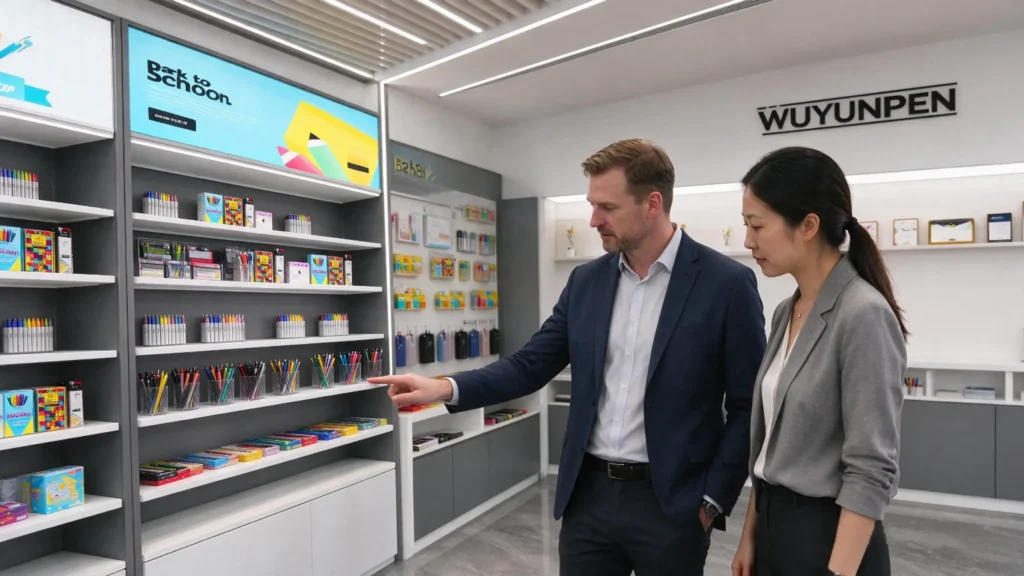
Quick answer: Stationery sourcing from China is most controllable when the buyer defines each item and destination, freezes measurable specifications, verifies the responsible supplier site, approves a controlled sample and releases shipment only against agreed evidence. The method applies to importers, brands, wholesalers and procurement teams evaluating a specific order—not to an undefined catalogue or an assumed “stationery factory.”
Stationery is a broad general-merchandise scope. A notebook, marker, stapler, children’s art set and battery-powered desk item do not share one production route or compliance file. The buyer must divide the programme into product families, identify which legal entity and site performs each critical process, and make the quotation, sample, inspection and destination evidence refer to the same specification version.
Key Takeaways
- Define the product before comparing suppliers. Material, dimensions, writing performance, binding, print, packaging, intended user and destination can change both cost and evidence requirements.
- Verify the site, not only the sales company. A business licence establishes identity information; it does not prove that the named site controls printing, ink formulation, plastic moulding, metalwork, assembly or packing.
- Make the approved sample a controlled reference. Record its version, materials, artwork, colour standard, dimensions, function and packaging; then define which changes require written reapproval.
- Separate quality inspection from regulatory evidence. Visual and functional inspection can test agreed characteristics in a sampled lot, but it does not replace chemical assessment, technical documentation or market-specific labeling review.
- Use stop gates as well as a score. An attractive total score must not override an unresolved legal entity, beneficiary mismatch, unapproved material change or missing destination-market evidence.
What Stationery Sourcing from China Can and Cannot Prove
A stationery supply-chain review can establish who performs the work, whether quoted capabilities match the order and which evidence must exist before payment or release. It cannot prove future performance from a marketplace badge, sample alone, certificate image or cluster address. Evidence becomes decision-useful only when it matches the legal entity, exact product, material, site, standard, destination and current order.
For a buyer comparing a stationery supplier in China, the correct unit of analysis is the transaction: one specification revision, one contracting structure, named production and subcontract sites, an approved sample, a defined lot and a destination-market evidence file. A supplier may perform strongly for paper notebooks but depend on unrelated subcontractors for markers, adhesives or metal desk accessories.
| Evidence | What it can support | What it cannot prove alone | Buyer check |
|---|---|---|---|
| Business registration | Legal name, registration details and recorded status | Product capability, quality consistency or future delivery | Reconcile the Chinese legal name with the contract, invoice and beneficiary |
| Supplier sample | A reviewable product at a stated version and date | Production-lot consistency or unchanged materials | Seal the approved reference and record every deviation |
| Test report | Results for the identified sample, methods and report scope | Coverage of a changed formulation, different model or unlisted site | Match model, materials, standard version, laboratory scope and date |
| Inspection report | Findings for the lot, sample size, checklist and inspection date | Untested chemical compliance or every unit in the shipment | Approve the sampling plan, defect definitions and release rule in advance |
Read the full guide here : How to Find Suppliers in China
How the Stationery and Office Supplies Value Chain Is Structured
For stationery sourcing from China, the value chain is a set of product-specific processes connected by printing, component sourcing, assembly, packing and export coordination. Buyers should map the route by item family rather than assume one site controls the complete assortment. In this article, stationery belongs to PUPULAN’s general-merchandise scope; it is not presented as a Wenzhou pillar industry.
01
Product architecture
Separate paper goods, writing instruments, filing products, desk accessories, art materials and powered items by materials, processes and intended users.
02
Component and process map
Identify paper, ink, adhesive, plastics, metals, coatings, printing, binding, moulding, filling, assembly and outsourced processes for each SKU.
03
Customization and approval
Control artwork, colour references, logo method, packaging dielines, barcodes, language, warnings and approved sample versions.
04
Production and lot control
Track incoming materials, first output, production milestones, approved changes, lot identity and corrective actions.
05
Packing and consolidation
Reconcile inner packs, assortments, cartons, marks, quantities and mixed-supplier handovers before loading.
06
Market and shipment evidence
Confirm destination rules, technical files, labels, commercial documents and release evidence for the exact shipment.
Stationery Sourcing from China: Product Specification Matrix
A stationery specification should convert product language into measurable RFQ fields. The matrix below identifies what a buyer should define and verify; it does not impose universal acceptance values. Set the actual limits from the intended use, approved sample, destination requirements and buyer standard.
| Product family | Define in the RFQ | Verify at sample or production stage | Change requiring review |
|---|---|---|---|
| Notebooks and paper goods | Paper basis and colour, sheet or page count, finished size, ruling, print, cover, binding and pack-out | Dimensions, count, print registration, writing show-through, page sequence, binding and opening behaviour | Paper source or grade, ink, adhesive, binding method, cover construction or printer |
| Pens, pencils and markers | Tip or point, line width, ink or lead type, barrel, cap or retraction, colour reference, marking and retail pack | Writing continuity, colour, drying behaviour, leakage, cap fit, mechanism, sharpening or breakage performance | Ink formulation, reservoir, tip, lead composition, plastic resin, mechanism or assembly site |
| Adhesives and correction products | Intended substrate, application method, fill quantity, drying or setting condition, packaging seal and warnings | Application, bond or coverage, drying, odour where relevant, closure integrity, leakage and usable fill | Formulation, solvent system, applicator, fill source, container resin or closure |
| Files and plastic stationery | Material, thickness, dimensions, capacity, colour, transparency, closure, weld or seam and print | Thickness, fit, opening cycles where specified, seam integrity, load behaviour, print adhesion and pack quantity | Resin, recycled content claim, thickness, welding process, closure component or mould |
| Staplers, scissors and desk tools | Materials, dimensions, compatible consumable, operating force, capacity, surface finish, edge treatment and packaging | Mechanical action, alignment, cutting or fastening result, sharp edges, finish, corrosion indicators and pack protection | Metal grade, heat treatment, spring, blade, coating, tooling or assembly process |
| Children’s art and activity materials | Intended age, foreseeable use, formulation, components, warnings, instructions, packaging and destination | Age presentation, small components, accessible materials, formulation identity, labels and report scope | Formula, pigment, fragrance, component, age claim, warning, manufacturing site or target market |
This map changes the supplier question. Instead of asking whether a seller is one of the stationery manufacturers China buyers often search for, ask which exact processes the quoted site controls, which processes are subcontracted, who approves materials and how the final lot is linked to the approved sample and evidence file.
For programmes assembled across several specialist sites, read the full guide here : Multi-Category Consolidation from China.
Which Supplier Capabilities Must Be Verified at the Exact Site
Verify the capabilities that create the buyer’s main failure risk at the site responsible for them. A catalogue, licence or sales presentation may identify a commercial counterparty, but site-level evidence should show how materials are controlled, processes are performed, samples become production instructions and nonconforming goods are contained.
- Legal identity and commercial role: record the Chinese legal name, registration identifier, address, contracting role, exporter role and bank beneficiary. Check the current record in China’s National Enterprise Credit Information Publicity System.
- Process ownership: identify what the site performs and what it outsources, including printing, filling, moulding, plating, coating, binding, assembly and packing where applicable.
- Material and change control: examine approved-material records, incoming checks, version control, substitution approval and traceability to the finished lot.
- Measurement capability: confirm that gauges, test methods and acceptance criteria fit the specification. Calibration labels alone are not enough if the method cannot evaluate the stated requirement.
- Defect handling: review how nonconforming product is identified, segregated, reworked, reinspected and prevented from re-entering the shipment without approval.
- Packaging execution: test barcode readability, assortment accuracy, carton strength assumptions, marks and pack-out against the buyer’s distribution route.
If a supplier cannot identify where a critical process occurs, then treat that capability as unverified and pause the award for the affected SKU. Do not average the gap away with a low price or a strong sample. Either verify the responsible site, redesign the requirement or remove that product from the order.
Stationery Supplier Scorecard
The following 100-point model is a recommended buyer tool, not an industry statistic. Adjust the weights before issuing the RFQ, score every candidate against the same evidence and keep critical stop gates outside the total.
| Dimension | Weight | Evidence reference | Supplier A | Supplier B | Supplier C | Open issue / owner / due date | Gate |
|---|---|---|---|---|---|---|---|
| Specification and sample match | 25 | Deviation list, sample ID, artwork and test record | — / 25 | — / 25 | — / 25 | Record gap, named owner and deadline | Stop for unresolved safety or functional requirement |
| Process and quality control | 20 | Process map, incoming checks, first-output approval and defect records | — / 20 | — / 20 | — / 20 | Record unknown process or missing control | Stop when a critical process or site is unknown |
| Identity and evidence integrity | 20 | Registry, contract, beneficiary, report scope and site reconciliation | — / 20 | — / 20 | — / 20 | Record contradiction and verification owner | Stop for unresolved identity or beneficiary mismatch |
| Comparable commercial offer | 15 | Itemized quotation, currency, validity, inclusions and named Incoterm | — / 15 | — / 15 | — / 15 | Record exclusion or non-comparable basis | Hold when the commercial basis is materially unclear |
| Milestones and change control | 10 | Schedule assumptions, approval gates, escalation and revision process | — / 10 | — / 10 | — / 10 | Record missing milestone or approval rule | Hold before an irreversible commitment |
| Packing and shipment readiness | 10 | Pack-out, carton marks, quantity reconciliation and document file | — / 10 | — / 10 | — / 10 | Record missing release evidence | Stop before shipment release |
How to Build a Stationery RFQ Checklist and Sample-Approval Process
A comparable RFQ gives every candidate the same product definition, commercial basis, evidence request and response format. For private label stationery sourcing, the buyer should distinguish fixed requirements from supplier proposals and require every deviation to be listed. Silence must not be treated as acceptance of an unspecified requirement.
Stationery RFQ Checklist and Worksheet
| RFQ field | Buyer requirement and revision | Supplier response or deviation | Sample or evidence ID | Owner and due date | Approval status |
|---|---|---|---|---|---|
| Product identity and use | SKU, description, user, age positioning and intended use | Exact offered model and declared deviations | Specification and sample reference | Named buyer or supplier owner and deadline | Open / Approved / Rejected |
| Materials and construction | Paper basis, plastic or metal grade, ink, adhesive, dimensions and tolerance | Material declaration, process route and substitutions | Material record and approved sample ID | Named technical owner and deadline | Open / Conditional / Approved |
| Performance | Writing, erasing, adhesion, binding, opening, cutting or other measurable function | Proposed method, result format and exceptions | Method revision and result record | Named test owner and deadline | Open / Pass / Fail |
| Branding and packaging | Artwork, colour reference, logo method, retail pack, barcode and carton marks | Dieline, print method, proof and pack-out | Artwork revision and packaging sample ID | Named brand owner and deadline | Open / Approved / Rejected |
| Quantity and quotation | Quantity by SKU and variant, target price and currency | Itemized price, MOQ, validity, tooling, sample, test and packaging costs | Quotation revision and normalization file | Named commercial owner and deadline | Comparable / Clarify / Reject |
| Trade and delivery basis | Destination, preferred mode and named Incoterm place | Incoterm rule, named place, version, assumptions and exclusions | Commercial term-sheet revision | Named logistics owner and deadline | Open / Approved / Rejected |
| Market evidence | Destination, channel, labeling, testing and documentation requirements | Available evidence, scope, gaps and action owner | Compliance matrix, report or label revision | Responsible importer or specialist and deadline | Open / Pass / Escalate |
After quotation, convert the selected RFQ into a sample approval record. Give the sample a unique identifier and freeze the matching specification, artwork and packaging revision. Record observations as pass, fail or approved deviation. If the supplier changes a material, component, process, site or subcontractor that can affect performance or compliance, require written disclosure and decide whether resampling or retesting is necessary.
Stationery Quality Control in China: Documentation and Market Evidence Gates
Release should depend on three separate gates: product conformity to the approved specification, completeness of shipment documents and suitability of destination-market evidence. Passing one gate does not compensate for failing another. The importer should define the product, intended user, destination and sales channel before deciding which rules, tests, labels or technical documents apply.
Quality-control gate
- Confirm production quantity and select the written sampling plan before inspection.
- Compare materials, dimensions, colour, printing, assembly and packaging with the approved reference.
- Use product-specific functional checks, such as writing continuity, cap fit, page count, binding strength, adhesive performance, cutting action or barcode scan, where relevant.
- Define critical, major and minor defects with examples linked to the product and destination.
- Record failures, corrective action, rework quantity and reinspection decision before release.
Documentation gate
Reconcile the purchase order, commercial invoice, packing list, product description, quantities, carton marks and agreed shipping documents. Where several suppliers feed one shipment, use an SKU-level reconciliation file so that the consolidator does not rely on carton totals alone. Document names and descriptions should be commercially accurate and consistent; they should not be rewritten merely to obtain a preferred customs result.
Destination-market evidence gate
For EU consumer stationery, Regulation (EU) 2023/988 requires only safe products to be placed on the market and applies to products in its scope from 13 December 2024; product identification and economic-operator information are part of the framework. Review the exact product and any sector-specific rules in the official EUR-Lex GPSR text. This statement was reviewed as of 2026-10-04 and should be rechecked quarterly.
For consumer art materials offered in the United States, the U.S. Consumer Product Safety Commission states that art materials require a toxicological assessment at least every five years and a specified ASTM D-4236 conformance statement. Children’s products or other product features may trigger additional requirements. Review the product’s intended use and current CPSC Art Materials guidance. This statement was reviewed as of 2026-10-04 and should be rechecked quarterly.
These examples do not create a universal stationery certification list. A plain office folder, children’s marker set, aerosol adhesive and electronic label maker can follow different legal routes. The responsible importer should confirm classification, applicable rules, test scope, labeling, technical records and customs requirements for the exact SKU and destination with qualified specialists where exposure is material.
Real limitations and scope: This method is suitable for professional buyers planning a defined stationery order with known SKUs, intended users and destinations. It is not a regulatory opinion, a factory audit report, a customs classification or a promise that inspection will find every defect.
It is not suitable for releasing an unidentified mixed catalogue, relying on certificate images without scope checks or assuming that a Wenzhou address proves stationery manufacturing capability. Confirm material, safety, customs and labeling decisions with the responsible importer, customs broker, accredited laboratory, certification body or qualified counsel as appropriate.
Shipment Release-Gate Tracker
A release decision should state whether the evidence is complete, conditionally accepted, unresolved or outside the buyer team’s authority. Record the reason, owner and next gate rather than relying on an informal “looks fine” message.
| Status | Meaning | Required record | Action |
|---|---|---|---|
| Pass | Required evidence is complete and consistent for the stated gate | Approver, date, file references and next milestone | Proceed to the next controlled stage |
| Conditional | A documented deviation is accepted within defined limits | Deviation, business impact, approving authority and expiry | Proceed only within the written condition |
| Hold | Required evidence or corrective action remains incomplete | Gap, owner, deadline and recheck method | Do not release payment or shipment at this gate |
| Escalate | The issue concerns legal identity, beneficiary, safety, compliance or another specialist decision | Contradiction, exposure, responsible specialist and decision deadline | Refer to the importer or qualified adviser before proceeding |
When to Buy Stationery from China Through a Factory, Trading Company or Sourcing Partner
For buyers planning stationery sourcing from China, the appropriate structure depends on assortment breadth, customization, evidence burden and the ability to manage separate suppliers. A direct factory can fit a concentrated programme where one site controls the key processes. A trading company can fit a broader assortment when its supplier roles and commercial responsibilities are transparent. A sourcing partner can fit a multi-supplier programme requiring one RFQ structure, sample tracker, milestone plan, inspection coordination and reconciled shipment file.
| Structure | Often fits when | Buyer must still verify | Main coordination burden |
|---|---|---|---|
| Direct factory | The order is concentrated in a process family the site demonstrably controls | Subcontracting, material control, evidence scope and export role | Buyer manages specifications, milestones and logistics interfaces |
| Trading company | Several related products require one commercial counterparty | Actual sites, role, margin basis where relevant, quality control and beneficiary | Trading company coordinates factories; buyer audits transparency and outcomes |
| Sourcing partner | A mixed programme needs independent comparison and one control workflow | Service scope, conflicts, supplier evidence, fees and contractual responsibilities | Partner coordinates; buyer retains product and importer decisions |
WENZHOU PUPULAN INTERNATIONAL TRADE CO., LTD. is an import-export trading and sourcing company that identifies, compares and coordinates independent factories. For a stationery programme, the most relevant services are supplier development and verification, sampling coordination, and pre-shipment inspection coordination. Scope, feasibility and commercial terms remain specific to the product, destination and order.
Review the operating model here : China Sourcing and Export Services.
Frequently Asked Questions
how do I source stationery from China
Start with a SKU-level specification and destination, then compare suppliers on the same RFQ, verify each responsible site, approve a controlled sample and set evidence-based release gates. Treat notebooks, writing instruments, art materials and powered desk items as different product families. Use the six-stage decision map in this guide before placing the purchase order.
what should be included in a stationery RFQ
Include the SKU, intended use, materials, dimensions, tolerances, performance tests, artwork, packaging, quantity, target price and currency, destination, named Incoterm place, and testing or labeling needs. Require a deviation list and itemized costs. The Stationery RFQ Worksheet uses seven fields so candidates answer on a comparable basis.
how do I verify a stationery supplier in China
Verify the Chinese legal entity in the National Enterprise Credit Information Publicity System, reconcile the contract and beneficiary, and identify the site performing each critical process. Then test capability through product-specific records, samples and site evidence. A marketplace profile or certificate image is a lead; it does not establish current scope or performance.
what should I inspect before stationery ships
Inspect the released lot against the approved sample and written checklist: quantity, materials, dimensions, print, colour, assembly, product-specific function, retail pack, barcodes, cartons and marks. Record the sampling plan and defect classes before inspection. Keep regulatory evidence as a separate gate because visual inspection cannot establish every chemical or legal requirement.
Does every stationery product need the same certification?
No. Requirements depend on the exact product, materials, intended user, claims, destination and sales channel. EU consumer products may fall within the GPSR framework, while U.S. consumer art materials have CPSC rules tied to ASTM D-4236. Determine the legal route SKU by SKU and verify it before production.
Can one supplier manage a mixed private-label stationery range?
Yes, but the buyer should verify whether that supplier manufactures, subcontracts, trades or consolidates each SKU. Use one master specification register and sample tracker while preserving site-level evidence. A single commercial contact can simplify coordination, but it can also hide process changes unless roles, approvals and shipment reconciliation are written into the order.
Authoritative Sources and Review Date
The official regulatory examples and company-registry route in this article were reviewed as of 2026-10-04 and should be rechecked quarterly. The three external sources are China’s National Enterprise Credit Information Publicity System, Regulation (EU) 2023/988 on EUR-Lex and the U.S. Consumer Product Safety Commission’s Art Materials guidance. Order-specific rules must be checked again when the product, material, intended user, destination or claims change.
Request the Stationery Sourcing Decision Pack
Send the product or specification, quantity, target price and currency, destination, preferred trade term, and testing, labeling and packaging requirements. For the defined programme, PUPULAN can structure:
- a comparable RFQ and supplier-deviation register;
- a supplier evidence and scorecard worksheet;
- a sample approval and revision tracker; and
- a preliminary inspection and shipment-release checklist.
Feasibility, service scope and commercial terms are confirmed for the exact product, destination and order.
Submit Your Stationery RFQJayden, Founder of PUPULAN
PUPULAN is a sourcing and export service company in Wenzhou, Zhejiang. It coordinates independent factories and export workflows; it is not a factory or manufacturer.
Further reading
Read the full guide here : Custom Notebooks from China: Paper, Binding, Printing and Packaging Specs
The notebook-specific follow-up to this guide: turn paper GSM, ruling, page count, binding, printing and packaging into one frozen specification sheet, then release bulk production only against a sealed sample and agreed inspection evidence.