
Quick Answer
Custom merchandise sourcing starts with a defined product, production-ready artwork and an agreed approval reference. Compare suppliers against the same specification, assess a representative sample where needed, and release the order against documented quality checks. The right route depends on quantity, construction, destination and the intended use.
Key Takeaways
Start Custom Merchandise Sourcing with the Intended Use
Define what the finished merchandise must do before selecting materials or requesting prices. A character display, wearable badge, promotional insert and retail keychain create different handling and presentation requirements. State the intended user, sales channel, destination and required use date so that suppliers can identify the relevant construction and evidence requirements.
WENZHOU PUPULAN INTERNATIONAL TRADE CO., LTD. is an import-export trading and sourcing company coordinating independent factories. PUPULAN can help organize supplier responses, sampling and order follow-up around a common specification; feasibility and commercial terms are confirmed for the particular product and order.
For custom merchandise for artists, identify the details that must survive the move from screen to object. These may include small lettering, a character’s expression, transparent areas or a particular silhouette. Confirm that you have permission to reproduce the supplied artwork and identify any restrictions on its use.
Choose a Product That Fits the Artwork
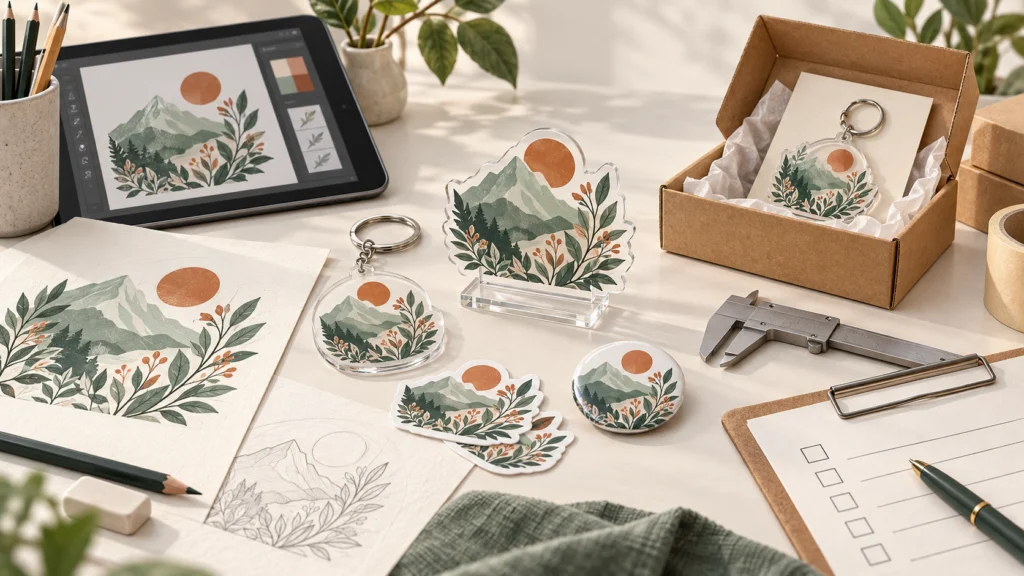
Select a product whose size, shape and construction support the design. Then evaluate its practical use: how it hangs, stands, fastens, peels or fits into retail packaging. The applications below are planning suggestions. Material performance, durability and suitability for a particular user still need confirmation against the selected specification.
| Product | Possible application | Specify before quotation | Evaluate in a sample |
|---|---|---|---|
| Acrylic keychains | Portable character or brand merchandise | Outline, print sides, hanging hole, finish and hardware | Actual-size detail, hanging balance and clasp operation |
| Acrylic standees | Desk displays and collectible sets | Assembled dimensions, base, slots and separate components | Insertion, fit, stability and viewing angle |
| Stickers | Illustration packs, inserts and decoration | Substrate, adhesive, finish, cut format and application surface | Liner release, application and adhesion under agreed conditions |
| Badges and pins | Wearable designs and collectible ranges | Body material, decoration, dimensions, fastening and backing card | Legibility, fastening function and presentation |
Printed bags and posters can extend a collection, but each medium needs its own material, print and packing requirements. Reusing an illustration does not make the production specification interchangeable.
Read the full guide here : custom acrylic merchandise
Freeze Artwork and Specifications Before Comparing Quotes
Give suppliers the same production package and ask them to identify deviations before you compare prices. Include the artwork revision, finished dimensions, material, print orientation, effects, accessories and packaging. A lower quotation is difficult to assess when it covers a different thickness, fastening, design quantity or packing arrangement.
Build a clear artwork handover
- Name each design and revision, with its quantity and product configuration.
- Define whether dimensions refer to printed artwork, the finished piece or the assembled product.
- Label front and back files and confirm how text should read on each side.
- Separate white ink, transparent areas and special effects where the selected process requires it.
- Confirm file formats, resolution at output size, cut-line responsibility and any required bleed using the current product instructions.
If your design uses text on both sides, then confirm separate front and back artwork rather than assuming a mirrored reverse will be readable. Review small details at their intended physical size.
Compare the full commercial scope
Request the currency, quantity breakdown, quotation validity, setup charges, packaging, sample terms, testing costs and shipping exclusions. Ask which options must match for different designs to share a quantity tier. Minimum quantities and any sample-cost credit should be confirmed for the selected configuration.
Verify the seller, production site and responsibility for printing, cutting, assembly and packing. Request relevant process records or a walkthrough when the order warrants it. A company licence establishes identity information; it does not establish control of every process shown in a catalogue.
Read the full guide here : stationery sourcing from China
Define Sample Approval Before Production Starts
Decide which uncertainties require a physical sample and which can be resolved through a digital reference. A proof can confirm layout, spelling and orientation; a suitable physical sample can help assess material, finish and assembly. Record the scope of acceptance so that approving the artwork is not mistaken for approving untested physical performance.
Sample approval rule
Approve a sample against a written question. If it was supplied to assess color and appearance, record those findings and identify any function, durability or packaging checks still outstanding. Carry accepted characteristics into the production specification.
Custom Merchandise Sourcing: Specification and Approval Checklist
- Reference: identify the controlling artwork, preview, reviewed design, proof or physical sample.
- Geometry: confirm dimensions, outline, hanging position, base and component fit.
- Appearance: record print sides, white ink, transparency, finish and the applicable color reference.
- Components: identify materials, hardware and permitted substitutions.
- Presentation: confirm quantity by design, backing cards, labels and protective packaging.
- Open items: distinguish approved characteristics from checks still awaiting evidence.
- Authorization: retain the order reference, revision, approval date, authorized person and change-control rules.
Confirm the ordering route before payment: some workflows use an editor preview, while others require a separate review or formal proof. A supplier-specific example is Glintmade’s artwork and production policy, which distinguishes these routes. Your order should identify the reference that actually authorizes production.
Inspect Against Agreed Criteria and Document the Release Decision
Define inspection methods and acceptance criteria before bulk production. For each important characteristic, agree the reference or tolerance, inspection conditions, sampling scope and response to failure. The checks below are a procurement framework, not a universal testing standard. Product-specific limits should be agreed with the supplier and, where necessary, an appropriate testing specialist.
| Check | Inspection approach | Agree before production | Evidence to retain |
|---|---|---|---|
| Artwork and print registration | Compare text, orientation, print position and cut alignment with the approved reference. | Correct revision, alignment limits and viewing conditions. | Reference comparison and photographs of deviations. |
| Dimensions and edges | Measure specified points; examine edges, hanging holes, cracks and chips. | Measurement basis, instruments, tolerances and unacceptable edge defects. | Recorded measurements and identified defect locations. |
| Surface and color | Review scratches, print coverage, transparency and finish under agreed lighting. | Physical reference where required, film-removal procedure and appearance limits. | Comparison records; photographs alone should not settle disputed color. |
| Hardware and fastenings | Operate clasps and fastenings; assess attachment security using an agreed method. | Component identity, operation criteria and any retention-test method and limits. | Functional results and test conditions. |
| Standee assembly | Assemble matching components and assess fit and stability. | Insertion method, acceptable looseness and intended support surface. | Assembly results and photographs or video where useful. |
| Sticker application | Check liner release and apply to the agreed surface under defined conditions. | Surface preparation, application conditions, evaluation timing and required behavior. | Material identification, conditions and observed results. |
| Quantities and packing | Reconcile variants, cards, labels, unit protection and carton contents. | Counting scope, assortment, pack configuration and carton marks. | Count records, label checks and packing photographs. |
Release, hold or correct and reinspect
- Release: applicable checks meet the agreed criteria, required documents are complete and the authorized reviewer records acceptance.
- Hold: artwork versions conflict, materials change without approval, required evidence is missing or a safety or market-access question remains unresolved.
- Correct and reinspect: identify and segregate affected goods, agree the correction and reassess the relevant characteristics before release.
Define critical, major and minor defects for the order, with examples and acceptance rules. Do not decide severity only after seeing the results. Any concession should identify the affected scope and authorized acceptance; it cannot resolve a legal or safety failure.
PUPULAN coordinates pre-shipment inspection on every order, with findings reported before release. Confirm the inspection scope: inspection on every order does not by itself mean every individual unit receives every possible test.
Before ordering, also agree how shortages, manufacturing deviations and transit damage will be documented and handled. This supplier quality-policy example distinguishes covered problems from approved artwork errors and changes of mind. Its remedies do not automatically apply to another supplier or contract.
Keep the delivery plan separate from production estimates
Work backwards from the required use date, allowing for approval, production, inspection, corrections, transport and delivery uncertainty. For consolidated orders, identify which unfinished item controls shipment readiness and compare a split shipment before approving additional freight.
Confirm the shipping service, named destination, cost inclusions and responsibilities in writing. A supplier delivery-policy example shows why transport estimates and address availability need separate review. It is not a delivery commitment for a PUPULAN order.
Scope and limitations
This framework supports commercial specification, sampling and quality coordination. It does not establish suitability for children, destination-market compliance or transport acceptance. Those questions depend on the actual materials, construction, intended use and route. Inspection does not replace required testing, labeling review or confirmation by the responsible importer and relevant specialists.
Prepare Your First Custom Merch Order Brief
Use the worksheet to turn an initial idea into a comparable inquiry. Attach the available files and identify unresolved points rather than filling them with assumptions. The supplier’s response should explain feasibility, exclusions and the next approval step. A requested event date or target budget is a buyer requirement until the corresponding commitment is confirmed.
| Field | Information to provide | Your requirement |
|---|---|---|
| Product and intended use | Product type, intended user, application and sales channel | |
| Size and construction | Finished dimensions, material, thickness and assembled structure | |
| Designs and quantities | Number of designs, quantity per design and variant breakdown | |
| Finish and hardware | Print sides, effects, white ink, transparency, attachments and finish | |
| Artwork and sample priorities | File revisions, available references and uncertainties to resolve | |
| Packaging | Unit protection, backing cards, barcodes, assortments and cartons | |
| Budget and currency | Target budget and whether it includes sampling, testing or freight | |
| Destination and trade term | Country, postal code or port, preferred term, named place and version | |
| Required use date | Your event or stock requirement, subject to feasibility confirmation | |
| Testing, labeling and open questions | Known requirements, inspection priorities and points needing clarification |
Frequently Asked Questions
What custom merchandise can I make from my artwork?
Your artwork can be adapted to products whose shape, material and viewing size preserve the important design features. Start by identifying the intended use and the smallest detail that must remain readable. For custom acrylic merchandise, ask the supplier to show the actual-size layout and relevant attachment or base before selecting the final construction.
Can I order a sample before buying custom merchandise in bulk?
You can request a sample, but specify which uncertainty it must resolve before agreeing its cost and scope. A stock sample demonstrates an existing product; a custom sample evaluates your design; a production-representative sample should match the agreed materials and process. PUPULAN can coordinate the request, with availability and commercial terms confirmed for the order.
How should I prepare artwork for custom merchandise?
Deliver one clearly organized production package using the selected product’s current instructions. Include the approved file revision, finished dimensions, quantity by design, front and back references, and separate effect information where requested. For acrylic keychains, explicitly confirm text orientation and hanging position, then ask the supplier to identify missing files before you authorize production.
Will I receive a proof before production?
A separate proof depends on the supplier’s ordering route and your agreed scope. Before payment, ask which preview, reviewed design, formal proof or physical sample will authorize production, who approves it, and which changes require a new approval. PUPULAN should record that decision in the order file rather than assume that every supplier follows the same sequence.
What should I check before reordering custom merchandise?
Review changes since the previous approved order before calling a reorder identical. Ask the supplier to confirm the artwork revision, material, printing method, accessories, packaging and production site, then check the new destination and intended use. Give PUPULAN the previous order reference and a written change list; affected characteristics should be reassessed before production.
Send a Brief That Suppliers Can Quote and Inspect Against
Share your artwork, product specifications, quantity by design, target price and currency, destination, preferred trade term, and testing, labeling or packaging requirements. Our sourcing and export team can review the scope and coordinate supplier responses, sampling and the agreed inspection steps.
Contact PUPULAN for Your InquiryJayden, Founder of PUPULAN
PUPULAN is an import-export trading and sourcing company coordinating independent factories. This guide focuses on specifications, supplier coordination, sample approval and inspection evidence.
Read the full guide here : about PUPULAN and our company profile
Supplier policies reviewed as of 2026-10-15; recheck quarterly and before relying on them for an order. These references describe the publisher’s own terms, not industry-wide standards, independent factory verification or terms automatically applicable to PUPULAN contracts.